I have been reflecting on the Incarnation again this year, and as last year my inspiration comes from the book of Philippians. God becoming Man is still something our finite minds wrestle with. It can be a theological quagmire that will consume your thought and every ounce of energy the ole grey matter can muster. I think the Apostle Paul’s words provide us with what is likely the closest description of what occurred in that event, but getting to the bottom of what Paul meant is a journey in itself. I have poured over the Gospel accounts, the New Testament letters, and the works of men who have known Jesus far better than I in search of greater understanding. I want a deeper relationship with Him. I want to truly know Him and to learn more about the intricacies about His mission. And so, the journey continues.
What follows may be a bit dry at times, but the academic pursuit is in many ways just as important as the numinous. God created us in His image, thus, giving us the capacity for abstract thought and the ability to reason and apply logic. We must use it in our journey to Him, because the rewards are immeasurable. He said, “You will seek me and find me when you seek me with all your heart.”[i] I take that as meaning our entire being, utilizing every attribute we’re comprised of in this pursuit. It is oh so difficult opening our hearts, and let us never forget that the greatest distance a man must ever travel is a mere 18 inches or so; that space which separates the mind from the heart.
Jesus Christ lived and died on this earth some 2,000 years ago. The mark he made upon mankind is indelible and continues to this day. More has been written about this magnanimous and sometimes enigmatic Figure than any other person since time began. His entrance onto the stage of mankind, “…whose name is not so much written as ploughed into the history of this world…”[ii] literally split recorded history in two.
Most of what we know of Jesus is found in the Bible. The Gospels of Matthew, Mark, Luke, and John give accounts of His remarkable life. Roman historians, Pliny the Younger, and Tacitus both wrote of Him, as did the Jewish historian Flavious Josephus. Early Christian leaders such as Clement, Ignatius, Polycarp, and Justin Martyr referred to His teachings in their writings as early as 96A.D. The entire New Testament is a study of His intimate impact upon people during His time on this planet and His continued influence after His departure; in fact, there would be no New Testament were it not for Jesus. That He lived is a given, Who He is and what He came to do has been on the minds of men for two millennia. Actually, since time began when you peer into the prophecies concerning Him. There is no more misunderstood and divisive personality to have ever lived. Some think he was a great moral teacher, some that He was the idea behind a movement, that He came to start a new religion, others consider Him a great prophet, while those that follow Him, even 2000 years later, believe that He was and is the very Son of God.
To understand why God became Man we must look back in time.
The backstory of the Incarnation begins eons ago with the most beautiful of the arch angels. Even among those wonderous creatures called angels, Lucifer was special. He was created to be a leader among the heavenly host. Some learned men speculate he may have been the worship leader in the heavens. He held what was likely the most important, dare I say, prestigious of positions in heaven as the one who covered the throne of God. He was before the throne always, continually in God’s presence.
It seems he succumbed to self-admiration, that evil incubator of hubris. He came to believe that he didn’t need to submit to God, because he could be god himself. In his pride, he led a coup against the Creator. He who was called the light-bringer, and was said to be full of wisdom and perfect in beauty, drew away a third of the angels, resulting in a war which raged in the heavenlies. Their rebellion infected the universe, reaching so far as that small blue orb we call home.
Through the creation accounts in Genesis and the book of Job, we watch as God interacts with His Creation, changing the Earth from a formless void to a habitat teaming with life. With the passing of each day, His creative acts become more intimate. We can almost hear the crescendo rise as we arrive on day 6, and see the entrance of Man. Man was the pinnacle of His masterful work, an object made in His own image.
We are witness to God’s demonstration of His love and devotion to the Man. As we enter the Garden we observe as He kneels on the ground, holding the Man’s lifeless body; his head resting in the palm of God’s hand as He gazes longingly at him. This Creature was unique, being an amalgamation of the physical world and a part of God Himself; he was a construct of matter infused with the Spiritual. Even as He made Him, the Lord had full knowledge that the Man would betray Him, and that Man’s actions would shake the entire universe. He knew the tragedy, the heartache, the horrors that Man would bring. Did the Lord weep as He held the Man? I think He must have. This soon to be errant child elicited tears of a Father’s heartache. This foreknowledge would cause any one of us to give pause, possibly to reconsider. We watch as tears stream down our Creator’s face. But there is oh so much more happening here, we see God’s face as it begins to change, as a smile starts to form. Our eyes behold His entire presence as He begins to glow, brighter and brighter, more refulgently than the sun; what we are witnessing is the manifestation of Love. God, holding the Man, pulls him closer still, His face pressed against the Man’s; He breaths the very breath of God into him, not merely life, but God’s life, Man becomes the recipient of Love itself.
God lovingly placed the Man in his new home; a Garden specifically made for him. We are told that God and Man shared in a friendship, and that he and God interacted daily. I like to believe this loving relationship lasted for hundreds even thousands of years, but I know that this is a mere fancy. How do I know? Because I know me, and I being the progeny of that first Man, know my heart, thus, I know his. It was likely a matter of days.
That rebellious arch angel, Lucifer, held a boundless hatred for God. He saw God’s love for the Man and he wanted to harm God any way that he could, so he sought to destroy God’s relationship with Man. He caught the Man and his wife alone, outside of the presence of God. He convinced the Man that God was a liar, and that Man could be his own ruler, his own god. Man embraced the falsehood, betraying his Creator, and yielded his station of ruler over Earth to the devil. Man won nothing, not even rule over himself. Thousands of years have passed since that tragic moment. Most of mankind throughout history has allied with the great usurper and his evil has proliferated. It was into this enemy occupied territory, amidst the destruction and chaos that Jesus Christ entered. He did not come as a warrior, a conqueror, but as the most vulnerable of all creatures, a human infant.
Christmas day had come.
An angel of the Lord heralded His birth. The message he brought was the greatest news of all time: the Savior, the Messiah had been born! As the angel ended his proclamation the sky lit up at the appearance of myriads of angels turning the night to day! The symphony of thousands upon thousands of angelic voices shouting with joy at His birth! It was as if those who resided in the heavenlies just couldn’t contain themselves and had to tell someone the great news! And then, just as suddenly as they had appeared, they were gone, leaving the sole recipients of their message standing alone with mouths agape. One would think that hundreds if not more would have witnessed an event of this magnitude. The Savior had just entered the world. But, no, the message was delivered to a small group of shepherds out tending their flocks. I’m not disparaging the station of the recipients by any means; it all just seems so disproportionate.
They went to see the Child, and they found Him just as the angel had said. They then told others about the message and the Babe, but again, the response seems subdued. Of course, Bethlehem was no major metropolis, having only 300-1,000 souls so, even if the shepherds went door to door proclaiming Jesus’ birth, at most 1,000 and say a dozen more counting the shepherds themselves would have received the message of this magnificent event. Even the Child’s new parents appeared to be reserved at His coming. We are also told that scholars and astrologers, wise men from eastern lands saw the appearance of His star and had come to celebrate and worship His coming. They had traveled great distances to Bethlehem to witness this wonderous event, but again, their part of His story seems toned down, even muted. It all seems so, anticlimactic.
But, isn’t this just like God? In a word, Humility. A humble God entered our world quietly, no triumphant entry, no fanfare. Contrast God’s actions with that of man. See what happens when the news of His coming reaches the ears of the mad king. His reaction to the Child’s birth was immediate and harsh, and is as typical of man, filled with violence and malevolence. Herod unhesitatingly ordered his personal guard out among the masses to commit murder—every boy-child up to two years of age was slaughtered to eradicate any would be messiahs that might try to assume his throne.
Such were the happenings of the first Christmas.
We can never understand the Incarnation, that event as C.S. Lewis called it, the Grand Miracle. How the second person of God, Jesus Christ became a child is beyond comprehension. But, as I mentioned earlier, I think St. Paul’s words provide us with what is likely the closest description of what occurred in the Incarnation. Philippians 2:6-8 is so intriguing. The Apostle, writing to the Philippian church, described Jesus’ entry into our world and his mission.
“…who, although He existed in the form of God, did not regard equality with God a thing to be grasped, 7but emptied Himself, taking the form of a bond-servant, and being made in the likeness of men. 8 Being found in appearance as a man, He humbled Himself by becoming obedient to the point of death, even death on a cross.”
The entire Gospel is encapsulated within those words. We see Christ’s divinity before time began, and His humility as He emptied Himself. This was not an emptying of His deity, but is better viewed as a self-renunciation, or a setting aside of His divine privileges, rather than removing them from Himself. He could still access those divine attributes but did not do so for His own sake. There are many passages in which we see Jesus’ humanity: John 4:6-7, Jesus is tired and thirsty; Mark 11:12, He is hungry; John 11:33-36, succumbing to His grief. There are also scriptures that express His divinity: John 10:30, His co-existence with God; John 1:1, His existence in eternity; John 2:1-11, His authority over Creation. A good example of His Godness and humanness contained within a single event is found in His calming of the storm in Mark 4:35-41. In this passage we find Him exhausted, asleep in a boat, a reflection of His being fully human. A storm began to rage and His disciples awakened Him. Jesus rebuked the storm and it immediately ceased, thereby displaying His divine authority over nature.
The opening words of the book of John explains where Jesus was prior to the Incarnation. John 1:1, “In the beginning was the Word, and the Word was with God, and the Word was God.” Meaning, that He existed even before anything was created. He, God the Father, and God the Holy Spirit, all three personalities of the Godhead in perfect unity, an interrelationship of love. We see Him reflecting on His eternal existence near the end of the Last Supper. Just prior to departing for the Garden of Gethsemane, Jesus offered prayers recorded in John 17:5 “And now, O Father, glorify Me together with Yourself, with the glory which I had with You before the world was.”[iii] And at the end of the prayer in John 17:24, “Father, I desire that they also whom You gave Me may be with Me where I am, that they may behold My glory which You have given Me; for You loved Me before the foundation of the world.”[iv]
Continuing on through Paul’s description, we find that Jesus took on not just the role, but the form of a servant. The word form used in the passage carries the meaning of character, and as is seen in the Scriptures, He completely submitted Himself to God the Father in the true nature and character of man. We see variations of this same word form later in Romans 8:29, and in Galatians 4:19 in reference to our own transformation into the likeness of Christ.
The words “in the likeness of men” mean that He submitted “…to being made like His brethren,” (Hebrews 2:17) “yet without sin.” (Hebrews 4:15) Jesus became like us in every way. He became one among the millions of other men. There was nothing notable about His appearance. He would disappear in the masses like any other man. (see Isaiah 53:2-3) Jesus’ total submission to the will of God is seen in this form, His humble obedience and desire to do the Father’s will extended (John 6:8) even up to death. This humility was publicly declared at His death on the Cross; the Cross being an accursed death, which He endured for each of us. Paul, writing to the church in Galatia referenced Deuteronomy 21:23 when he said, “Christ redeemed us from the curse of the Law, having become a curse for us—for it is written, ‘Cursed is everyone who hangs on a tree.’”[v]
An exploration of Scripture reveals that the Incarnation was the initial plan from the very beginning. Yes, it was a response to something gone awry, and it was a rescue mission, but it was the original plan. This is the most difficult part to grasp. The word response connotes a reaction to some prior action, but the Incarnation was in position number one of God’s plan; it was in place prior to the Fall. God knew that man would betray Him, but yet He still created man. God foresaw what would happen in the Garden and all of the evil that would follow, and He still made man. If God knew the first Man’s actions, we can infer He foreknew each of us, thus, we were each in His mind prior to Creation. He saw everything that you and I both would do, the pain and the suffering that we would cause individually. Each of these acts were ultimately sins against Him, yet He willingly paid the debt for those sins on the Cross. Think about that. In full knowledge of each of our betrayals, He still proceeded forward with His plan. Jesus’ birth and Sacrifice were the first factor in the plan and we see this in Revelation 13:8 when the author referred to Jesus as “…the Lamb slain from the foundation of the world.” This theme is reinforced in 1 Peter 1:19-20, “But with the precious blood of Christ, as of a lamb without blemish and without spot: who verily was foreordained before the foundation of the world, but was manifest in these last times for you…” Again, the Incarnation was the plan from the beginning.
Belief in the Incarnation requires faith. When people hear the word faith, they often think of what is really blind faith. Blind faith is equivalent to a fool’s errand, it is groundless, and pointless. It requires no evidence for the belief. It is illogical and can even be harmful. Faith, authentic faith is far different. Our word faith comes from the Latin word fides, meaning trustworthiness, belief, confidence in something. Jesus desires us to “love Him with all of our hearts, our minds and our strength” and to do so requires a fides faith. It is a conscious decision based upon evidence, confidence, and trust that each of us must make. To have faith in Jesus is to have faith in a Person, to find Him to be trustworthy, and Someone we can have confidence in. You cannot come into the personification of Love without being moved to take action, to experience Him. Using that term, personification in reference to Him seems anthropomorphic, almost irreverent. To proclaim He is the epitome of love is better, but it still falls short because I am still using words that describe Him via a comparison. How does one describe Jesus Christ; He who is incomparable, indescribable, incomprehensible?
He is Love.
What He displayed in the Incarnation and again at the Cross, was Love.
Love is not merely a feeling, it is preference of someone else’s needs above our own.
Love is commitment to someone.
Love is caring and commitment.
Love is nurturing one another through trust and understanding.
Love is being vulnerable.
Up to 2.6 billion people now claim allegiance to Jesus Christ and it is estimated that between 8 and 13 billion have called Him their Savior since the Incarnation. People do not simply follow an idea; they do not willingly sacrifice themselves for something learned strictly intellectually. A person only makes the sacrificial level of commitment to that which he believes when it reaches the degree of faith. Faith must be acquired experientially, evocatively, it must awaken the person to something higher than himself. 70 million of those billions of believers were so committed to Him, that they submitted to some of the cruelest and most tortuous methods of capital punishment ever conceived. Each of those martyr’s sacrifice attests to their faith in Jesus Christ.
The Incarnation was a fulfillment of every aspect of Love. He committed Himself to reconciling us to God. He was the Sacrifice to accomplish it as well. He willingly became a Servant to all men. He has continued to care and nurture those who have faith in Him throughout history. As I think about this, I can think of no greater display of trust and vulnerability than the God of the universe becoming an Infant and placing Himself into the hands of man.
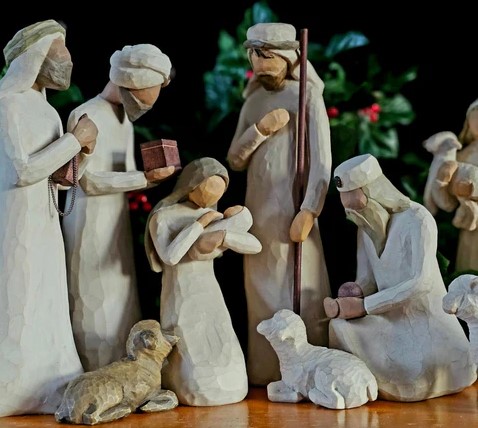
We now see His mother leaning over the manger, looking upon Him with love and adoration. A cow gently lows in the background and a young lamb bleats. The earthy smells of dirt, hay, and animals fill the air. The visiting shepherds gaze in awe at the Child; He is just as the angel told them. Furtive smiles are shared as they glance at one another, and the occasional subdued laugh of joy escapes them. Joseph stands on guard as he takes in the scene, pulling his mantle closer to stave off the chill in the night air. He thinks about all that has occurred in these past nine months. He is still baffled at his being chosen to raise the Boy and hopes he is up to the task. Mary reaches in the manger, gently picking up the Babe. She has bound Him tightly in the swaddling clothes to protect Him and give Him that sense of comfort that infants require, that feeling of being yet in the womb. She looks longingly into His eyes. She reflects on the things told to her by the angel nine months ago. Joseph’s own encounter with an angel as well. Those things her cousin Elizabeth said to her during her visit with her in the hill country. She thinks of Simeon and Anna and those words they spoke at the Child’s presentation at the temple. She ponders the wonderous gifts left by those strange, learned men from the east. She thinks of the suffering which awaits Him in the future, and feels the tightness in her chest at the thought. As tears fill her eyes her heart begins to ache, yet, there is something else simultaneously filling her heart; it is joy, abundant joy. She holds the Babe’s head gently in her hand and smiles as a thought courses through her mind, “I am holding my Adonia, my God.” She pulls the sleeping Jesus closer still, pressing her face to His. With a kiss, she fills His heart with that very thing given to the first Man all those years ago: Love.
It is Christmas Day.
C. Klingle
[i] The Holy Bible, New International Version. Colorado Springs, CO.: International Bible Society,1984. Jeremiah 29:13
[ii] https://emersoncentral.com/texts/nature-addresses-lectures/addresses/divinity-school-address/
[iii] The Holy Bible, New King James Version. Nashville, Tennessee: Thomas Nelson Publishers,1982. John 17:5
[iv] The Holy Bible, New King James Version. Nashville, Tennessee: Thomas Nelson Publishers,1982. John 17:24
[v] The Holy Bible, New American Standard Bible. Grand Rapids, Michigan: Zondervan Publishing House,1995. Galatians 3:13





 Curtis Klingle
Leave a comment