“I believe in Christianity as I believe that the sun has risen, not only because I see it, but because by it I see everything else.” C.S. Lewis
We really only see a small portion of this world as it truly is. Information received through our senses is affected by our subjectivity—actually, it would be more accurate to say it is tainted. Because of this, I have learned it is not so much what we are seeing, but rather how we are seeing things which is of far greater importance.
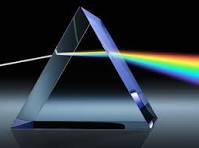
I believe a prism can help provide us with an adequate analogy. To refresh your memory, a prism is typically a triangular piece of glass or other translucent material that can be used to separate light into a spectrum of colors. Our primary source of light is the sun, and the light emitted by it is called white light. This white light allows us to see our world and is actually a composite of different frequences of light. For our purposes, we could say that white light provides us with an objective view and it displays things as they really are. When white light enters a prism, it is refracted and what results is a dispersion of the light into individual colors. Similarly, we each have a prism/paradigm through which we view events in our lives, and this prism actually causes distortion in varying degrees of what we are seeing, thus, affecting how we are seeing.
None of our prisms are flawless. Some prisms may be cracked, or have internal imperfections, perhaps even have a chip or two, while another might be speckled with debris or contains some other anomaly. These imperfections in our prisms influence our ability to see objectively because they tend to obscure or possibly even magnify a situation; in either case, the how we see is unique to us and our own life experiences. As with the refracted light, I may be more focused on the red color, while you may be drawn more to the blue, yellow may capture someone else’s attention, and yet others may be seeing things in another color variation; in much the same way, our own paradigm/prism, refracts the way we see things.
Being that our view is so limited, a more complete perspective can be attained by looking through the lens of another’s eyes. Virtually all misunderstandings and erroneous perceptions are simply a matter of how we are seeing something. We must be willing to see things through another’s prism. We must peer into that place where all of the senses come together, that depository of all of our experiences in this life; it is in the heart where we find the fuller picture that has been painted through the viewer’s own flaws and limitations, his longings, dreams, victories, failures, and when this perspective is combined with our own, things formerly unseen come into view. When we listen to someone speak, share an anecdote, or read the words of another, we gain a glimpse of what is inside their heart—we see things through their prism.
One of the most beautiful things I have ever heard came through the words of a little tow-headed girl. I think of that moment in time often. We were walking in the large backyard of her home just enjoying the wonders of nature. We listened to the squirrels chattering in the trees and took in the myriads of scents wafting on the air. As we walked, I could feel the grass give way under the weight of my feet, and the crackling sound of small twigs breaking as I tread over them—I was immersed in nature in all of her splendor. I looked over at my walking companion and watched attentively as she slowed her pace, coming to an abrupt stop, and saw as she raised her index finger to her lips, shushing me instantly. She said, “We must be very quiet,” as she looked ahead of us with intense caution in her eyes. “You have to sneak up on the flowers if you want to really see them.”
I have never looked at a flower the same since. I saw the world through her eyes just for a moment, and yes, they do seem to reveal more of their beauty if you are careful not to disturb or startle them.
Conversely, sometimes the prisms we encounter are not so inspiring, and can in fact be disturbing with what they yield. When looking through another’s eyes we can see some of the darkness and ugliness that has affected, and in some cases, infected them. We all carry scars in this life, and by definition a scar is the evidence of a wound that has healed. But for many, the wounds have never been allowed to heal, but instead fester and leak their insidious poisons into their host. It is as if they can no longer see through anyone’s prism but their own. Theirs has become locked onto a single facet filtered through the turbid venom and all they see is skewed. Oddly enough, they want to be healed but refuse to relinquish their envy, disappointment, hatred, and unforgiveness. Someone must pay the debt for these wrongs they experienced, whether real or perceived. As you peer through their prism you will see that the putrid sore resulting from the compound interest of resentment and hate they have levied bears little resemblance to the original injury. That debt must be collected though and virtually anyone touching that sensitive place within them can be assigned the responsibility of remuneration.
Invariably, that debt ends up being transferred to God himself and often leads to disappointment in Him and at its extreme, disbelief. But this disbelief is oddly shaped because it is one that hates Him, rather than simply not believing in Him. We should all strive to be compassionate to these poor souls as we may be the one who is able to help them to break through the pain and suffering. But be aware, there is real peril awaiting those who enter their hearts.
This all brings me to seeing things through the prism of Christ, of which there has been much fuss made about. There have been countless books written on the subject, essays galore, and the modern podcasters addressing this topic are endless. I have personally discovered that as long as I have had ample sleep the preceding night, it’s not too close to lunch, I’m in a good mood, and you haven’t irritated me to any great degree, I’m quite adept at seeing things his way and being Christlike.
On a serious note, I strive for this daily, and daily, I fail miserably at it. It is the most difficult way to see this world, because seeing things His way requires me to remove my own prism and replace it with his. To maintain his perspective will test your metal and it will take every ounce of your will and total submission.
Jesus provided the most simplistic instructions imaginable to view things his way, and these instructions come in the form of injunctions. When asked what the greatest commandment was, Jesus unhesitatingly responded,
“‘You shall love the Lord your God with all your heart, and with all your soul, and with all your mind.’”
He then quickly followed his response with an unsolicited addendum,
“And the second is like it; ‘You shall love your neighbor as yourself.’”[i]
Jesus wanted to leave no doubt as to what God expects of us, and that the focus was to be on love. We must bear in mind too that the questioner was a lawyer of the religious elite. These men were hypocritical, focusing on the minutiae of the Law and completely missing the message. The responses Jesus gave were summations of Deuteronomy 6:5 and Leviticus 19:18, the message which they had obviously missed. As Jesus so eloquently put it, these commands are upon which “…hang all of the law and the prophets.”[ii] In other words, loving God and loving our fellow man fulfills all of the instructions given to us from Genesis to Malachi.
Now, as if the bar wasn’t already high enough, and as is customary with Jesus, He raised it yet higher still. In John 15:12 He said, “This is My commandment, that you love one another, just as I have loved you.”[iii] These words spoken to the Twelve and anyone else within earshot in that upper room, would come to understand more fully what those words meant in just a few hours as Jesus hung upon the cross. Many years after the Last Supper, the Apostle Paul defined Christ’s love explicitly leaving no room for speculation,
“Love is patient, love is kind and is not jealous; love does not brag and is not arrogant, does not act unbecomingly; it does not seek its own, is not provoked, does not take into account a wrong suffered,does not rejoice in unrighteousness, but rejoices with the truth; bears all things, believes all things, hopes all things, endures all things. Love never fails…”[iv]
When I read that definition of love, I see how broken I truly am. To love as Jesus does is impossible outside of a relationship with Him. This love is a sacrificial love, an all-forgiving love, and a selfless love. When I look through the prism of Christ what I see is a light that is, rather than being multifaceted as with a typical prism, is concentrated into a single defining frequency. It is an emission of light. Everything that I experience is filtered through the lens of love and it is evident when I am seeing this world through his prism. That all-consuming love makes everyone, and everything take on a richness that I cannot perceive outside of him. I transform into someone far more gracious and understanding; kindness becomes as natural as breathing. It is as if some change, something akin to a spiritual chemiluminescence takes place and I begin to emit that Christlike love. A smile becomes infectious and elicits the same from others. Honesty rules in every situation. What is more, I come to sense I am in a constant state of fellowship with my Teacher.
However, when I am not in that state, that too is just as obvious. Anxiety, resentment, and anger become the norm. Patience is nonexistent, and callousness and rudeness prevail, and if we return to the definition, we find the problem immediately, right in the middle of what Paul wrote, love “…does not seek its own.”
It is in those times that the many faults I find so glaringly obvious in others are reflected right back at me. It is as if he has finally had enough of my judgmental childishness and swings a mirror in front of me. I have learned that the moment I sense my hackles rise is when I must pay close attention and ask why I am feeling that way. Chances are that the sensation I am experiencing is because I see something in the person I am observing that is alive and well within me. Oh, how I rue those days. Seeing through the eyes of Christ can humble, and humble us they should.
While we may not have any Pharisees or Sadducees breathing down our necks, what we do have is selfishness, misanthropy, and a constant bombardment of distractions on a grand scale, but the command to love has not changed, his mandate still stands. We must also understand that loving God and loving each other as Christ loves is proof that we belong to him. To not do so is not just contradictory, it is the antithesis of what Jesus intended. And being that it is diametrically opposite, we can further deduce that it is also diabolical. The fires of hell are so easily stoked in the human heart.
There is no greater calling that a human being can answer than that of becoming a disciple of Christ. I think of the joy that I experience when I am in lockstep with him, and that peace which surpasses all understanding which envelops my heart when I view things through His prism. It is difficult yes, but oh so rewarding. It is in those times when I can see things clearly with everything illuminated by His love that I sense I am closest to Him. Even with these mountaintop experiences there is something far greater that keeps me going in the face of every adversity. For I know that as I once again descend into the valley, I will invariably fall flat on my face. It is the knowledge that He is always there with me, to pick me up, dust me off, and send me on again. But, the greater thing, the grandest thing, the summum bonum is the hope of when I do cross the finish line of my race, that when I do meet that glorious Face, the one I have longed for my entire life, I will hear these words,
“Well done good and faithful servant…enter into the joy of your Lord.”
C. Klingle
[i] The Holy Bible, New American Standard Bible. Grand Rapids, Michigan: Zondervan Publishing House,1995, Matthew 22:37-39
[ii] Ibid., Matthew 22:37-40
[iii] Ibid., John 15:12
[iv] Ibid., I Corinthians 13:4-8





 Curtis Klingle
Leave a comment