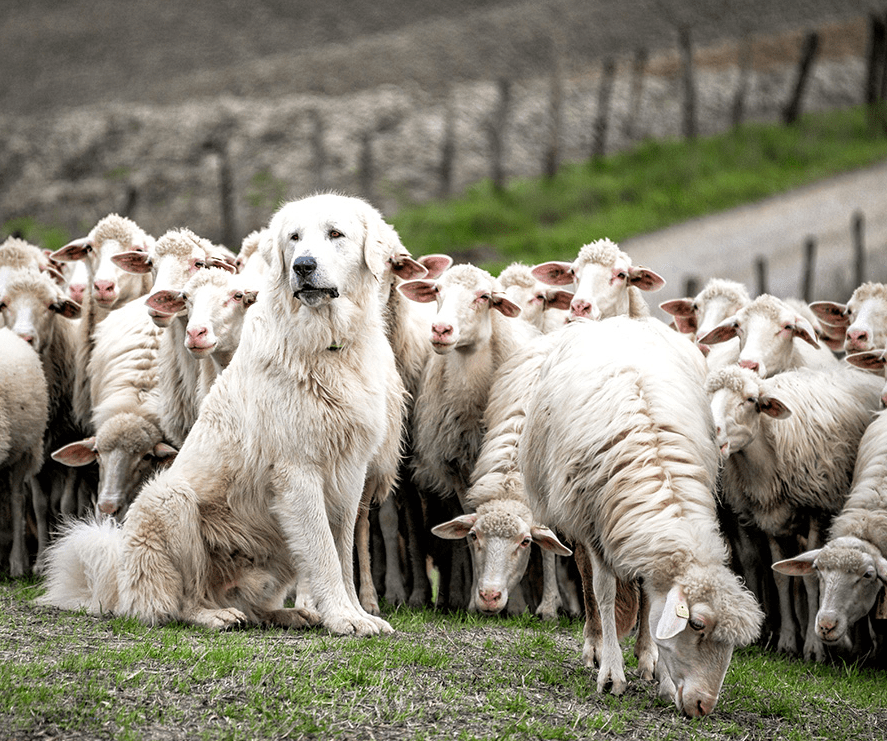
Sheepdogs
Lt. Colonel Dave Grossman, author of the book “On Killing,” wrote an essay titled, “On Sheep, Wolves, and Sheepdogs.” This essay was rooted in a conversation he had with an old Vietnam veteran. Through his insightful observations, the old vet deduced that there were basically three segments of society: Sheep, wolves, and sheepdogs. Grossman explained the differences between the three this way.
“If you have no capacity for violence then you are a healthy productive citizen, a sheep. If you have a capacity for violence and no empathy for your fellow citizens, then you have defined an aggressive sociopath, what we could call, a wolf. But what if you have a capacity for violence, and a deep love for your fellow citizens? What do you have then? A sheepdog, a warrior…”[i]
Grossman went on to say, “Understand that there is nothing morally superior about being a sheepdog; it is just what you choose to be.”
While I would agree that there is nothing morally superior about being a sheepdog, and I may be splitting the proverbial hairs here, but I would say that regarding the latter part of his statement, Grossman is in error. I do not believe one chooses to be a sheepdog; you either are, or you are not. I do however believe that you will make a choice of whether you will fulfill that role or not. I also think that those who choose a profession in the military or law enforcement, in more cases than not, possess those attributes of a sheepdog as described by Grossman.
Please understand, there are sheepdogs in all walks of life. You will find that the title of a sheepdog is also applicable to many in other professions, such as mechanics, electricians, carpenters, and brick layers. They may also be the baker at the corner bakery, the local butcher, a waiter at your favorite restaurant, even the kid that mows your lawn may very well be a sheepdog.
With full knowledge that I may be venturing into the philosophical or spiritual realm, if those in the military or law enforcement were to take a moment to reflect, I believe most would find that the job actually sought them out, rather than vice versa. While certainly expressing an interest in their careers, things seemed to just line up and direct them in an extraordinary way. The stars and planets didn’t just align; they smiled upon them. The difference between the other sheepdogs and those in the military or law enforcement, is that the latter have taken the role to a higher level and have chosen to step into the front lines and place themselves directly between the sheep and the wolves. They recognize their role as the first and last line of defense between the sheep and the predators and they brazenly declare it, typically by donning a uniform, while understanding that the uniform also serves as a “bullseye” for the cowardly wolves who will surreptitiously target them.
As I pondered Grossman’s metaphor of the sheepdog, what came to mind was the Great Pyrenees. This gentle giant is one of the most majestic of all canines. It originated in the Great Pyrenees Mountain range which straddles the borders of France and Spain. It was bred specifically to protect livestock from the ever-present threat of predators, primarily wolves and bear.
With the extirpation of wolves and bear from the Pyrenees Mountains during the 19 century, the Great Pyrenees were no longer needed and by the beginning of the 20th century they came very near to extinction. Fortunately, a French aristocrat, Benard Senac-Lagrange recognized the Great Pyrenees’ magnificence and began collecting and breeding the finest specimens he could find in order to preserve the species.
Fast forward 70 years or so and the 1990s saw a resurgence of the wolf, as well as bear populations in the Pyrenees mountains. As one might expect, the resulting increase in numbers of these two large predators led to higher predatory losses of livestock. The government answered by providing farmers and shepherds with the Great Pyrenees and not surprisingly losses rapidly declined as a direct result of the re-implementation of these sheepdogs. In the early 2000s it was reported that shepherds utilizing the Great Pyrenees saw a 90% reduction in livestock losses to predators.
As the Great Pyrenees is still needed in modern times to protect the shepherds’ herds from wolves, the sheep dogs of society are needed, probably more so than ever. These are troubled times in which we live. Studies show that the numbers of those that exhibit psychopathic and sociopathic tendencies have increased as much as 20% in corporate and criminal settings. As a rule, some 1% of the population (that is one person in a hundred folks) now exhibits these characteristics.[ii] Case studies on these individuals have shown that they are devoid of empathy and they seek out the weak, just as do wolves in the wild.
Wolves have always walked among us, but there are a number of factors which have served to exacerbate the problem of predators we now face in society. The anonymity of social media has been the number one contributor to the rapid increase of those having psychopathic and sociopathic tendencies, and it is an incubator for these types of behavior. Along with this societal malady, we find that misanthropy is at a level never witnessed before and is only growing. Within the construct of the world wide web there is limited, if any repercussions for antagonistic and or aggressive behavior, which allows freedom for greater levels of aggression and hatred. As with any behavior or action we perform regularly, it can and often does become habitual and can work its way out into our interactions with others. In the case of the psychopath or sociopath, his behavior in the “web world” can and does step over the threshold into the “real world.” One could also argue that much of the population has been desensitized to violence and death, via movies and video gaming.[iii] If you are constantly exposed to, and even rewarded for violent acts, including murder, such as experienced in video gaming, there is undoubtedly going to be negative repercussions. There have been numerous studies conducted to ascertain whether this is so, and they basically fall into either a yes or no camp. All of these studies though can be traced back to the famous Pavlov’s dogs experiments in classical conditioning in which sensitization and desensitization to stimuli was demonstrated vividly. This opened the door to testing this now proven theory in animals to the hypothesis that the same effects could be elicited or rather programmed in human beings. There is an infamous study titled, the “Little Albert” experiment in emotional conditioning in which an infant was the test subject. Conducted in 1919 by John B. Watson and Rosalie Raynor, the disturbing “Little Albert” experiment affirmed that human beings can be sensitized, thus, desensitized to specific stimuli. Dave Grossman explores desensitization specific to killing in his book, “On Killing.”
Another major factor which has resulted in directly affecting the numbers of sheepdogs present in our society, has been the appalling campaign to feminize the American male. This movement gained speed during the 1990s and has continued to accelerate. It has been largely effective too, resulting in not the nurturing of our young men, but the neutering of a major percentage of our population. Understand, predators walk among us and without men, the sheepdogs among us, we would be in bad shape indeed. Man has had to endure times of trouble throughout history, and it is during those times that the sheepdogs arise from their sleep. However, with this resulting emasculation of the American male, we are witnessing submission to aggression and cowardice as we have never seen at any other point in history. This in turn only empowers the wolves to a greater degree and increases their violent tendencies. A wolf will not stop until either corrective action is taken, or they are quite simply put down. As for the latter, there are some for whom this would be the most humane action to take. If you doubt, I challenge you to read or watch the news about the atrocities committed by the drug cartels on our southern border, or what goes on inside our prisons. I think you will come away with a different perspective about wolves.
I would also add that Grossman’s essay, while accurate in its division of the population, is in error with the assumption that the sheep “…have no capacity for violence…” All human beings react to violence or fear in one of three ways: fight, flight, or freeze. Whether you believe you are or not, you are capable of violence when pressed; the question is, “Will you fight?” What is more, we are each capable of absolute horrors. If you question this statement, imagine someone harming your spouse or a loved one and then evaluate the thoughts subsequent to that fiction, and you will see what I am talking about. Oh, and let us not forget that there are women who carry the sheepdog within them. If you doubt a woman’s ability to exact violence, just try to harm or take one of her children. You will find out first hand just how much she has in common with a bear protecting her cubs.
Another difference between sheep, sheepdogs, and wolves, is that the latter two will more readily implement violence. The wolves will do so for selfish and cruel motivations, while the sheepdogs will resort to violence to protect the sheep or themselves. Those in law enforcement actually applaud those sheepdogs who take immediate action against the intimidation and violence perpetrated by the wolves. This administering of “corrective action” can and often does lead to the wolf making life changing decisions when he has discovered that being a wolf is not very prosperous.
I also believe that you can teach a sheep sheepdog skills, but no matter how well you train him, he will never be a sheepdog. Sheepdogs are like leaders, you can’t make them, they are born.
A sheepdog recognizes something about himself that a sheep may not, that being that there is an alter ego, a violent man slumbering within him. He knows this other man is dangerous and capable of great violence, thus he keeps him under lock and key. But I say to you, if a man is not capable of accessing this beast within and exacting violence when necessity dictates, then he is not a “peaceful man,” no, he is in fact a harmless man. Having the knowledge that you have this capacity for violence makes you implacable; this is the heartbeat of the sheepdog, and is exhibited as meekness by the authentic sheepdog, and this is in no way a subterfuge or deception. Meekness is not weakness as many believe; meekness is by definition: strength veiled.
I have seen a small child take a stance against a grown adult in defense of a sibling or a parent suffering an assault. And yet I have witnessed grown men freeze and cower in the face of confrontation. This is the very reason why terrorism is so effective. Terrorists and bullies are nothing more than wolves of the worst variety. They instill fear via shock and aggression in order to cause submission.
A case example would be the terrorist attacks of September 11th, 2001. Out of four hijacked flights, three were effective in causing mass death and destruction; only those aboard United Airlines Flight 93 are known to have fought back. From the time of hijacking at 0928hrs to the time of its crash at 1003hrs, 40 people decided that they were not going out without a fight. The cowardly terrorists learned fear that day when those they erroneously believed were mere sheep, attempted to retake the craft. Sadly, all aboard lost their lives, but they did so while being a sheepdog.
On August 21st, 2015, three friends vacationing together were traveling by train from Amsterdam to Paris when they had to exercise their roles as sheepdogs. Spencer Stone, an active member of the U.S. Airforce, Aleksander Skarlatos, a soldier with the U.S. National Guard, and Anthony Sadler, all unarmed, subdued a terrorist equipped with a rifle, a handgun, and a boxcutter. Stone was severely injured during the confrontation, but he, nor his friends stopped until the terrorist was beaten unconscious. Events like these, though rarely publicized, happen daily across the world. Sheepdogs everywhere are confronting the wolves.
I am in no way a politically correct creature, but I do care how people view us, for I too am among the number of sheepdogs. That being said, I felt it necessary to add the following specifically for those in law enforcement and the military. We must bear in mind that the public fears sheepdogs very similarly to the way the Great Pyrenees is feared by the sheep he protects; though their protector, at times he is like the wolf in his actions; they know that he could harm them, thus they are wary. However, after time has passed, they realize that he can be trusted and he is eventually treated as one of the herd. Like the Great Pyrenees, the sheep we protect sometimes see us too as wolves. This fear is often exacerbated by the erroneous view the liberal media typically portrays the sheepdog, and sometimes that perspective is so slanted that the wolf is portrayed as a victim. The root of this fear is found in misunderstanding of course, but because the sheep fear us, we must actually show them and provide the necessary evidence that we can be trusted; they must be able to witness the truth for themselves that we are not wolves even though we sometimes must take violent action against predators. We must make every effort to show those of our herd that we are kind and considerate, and that we have a genuine love for them. One way to accomplish this is through acts of kindness, and I encourage you to seek out ways to help others. These acts can be as simple as the stereotypical “getting a cat out of a tree” or “helping an elderly woman across the street.” What about taking the time to talk to a shy child hiding behind his parents’ leg, or even simply holding the door open for someone? By performing these good deeds, we provide evidence through which the sheep will begin to see who we really are: a sheepdog.
Regarding the wolves we encounter, violence truly does beget violence, and predatory violence must be dealt with swiftly and harshly, and with greater violence. But once the situation is defused, we must show compassion, even for the wolf. This is what separates us from them; our ability to be violent and yet still show empathy. For a sheepdog to display compassion for the wolf, it can alter his entire paradigm, and in some cases does initiate near miraculous changes. What is more, the sheep will also witness the stark difference between our violence and that of the wolves.
Hubris has no place in the sheepdog, and we should each root it out savagely, and then we must replace it with meekness. I refer you again to the Great Pyrenees, and ask that you think of him patrolling the ranks of his flock. There is nothing about him that gives the impression that he thinks too much of himself. He is not imperious or grandiose, he just is. As I previously stated, meekness is not weakness, meekness is strength veiled.
In closing I leave you with the following to ponder,
“Those who abjure violence can only do so because others are committing violence on their behalf.” George Orwell, “Notes on Nationalism” 1945
“It burns with a white rage against societies as a whole, from military leaders and chiefs of state to comfortable civilians in easy chairs, who send rough men out to serve their interests brutally, murderously (what is war?), and then—when circumstances change and in the exquisite safety and fastidiousness of their living rooms they suddenly find these rough men’s actions repugnant—disown them.” Richard Grenier, “The Uniforms That Guard Us” 1981
For those that recognize the call to service as a sheepdog, I challenge you to reflect upon it. Be mindful that it will often be thankless, and at times you may even be persecuted for it. Will you answer this call with integrity and honor, as well as the service owed to your fellow man? Will you take upon yourself the mantle of the protector? Will you make the decision to accept your calling as a sheepdog?
C. Klingle
Sheepdog
Published in “The Blues” magazine October 2025 Issue https://www.yumpu.com/kiosk/theBLUES/oct-2025-blues-vol-41-no10/70784217/106
[i] Grossman, Dave, (2005). On Combat. Human Factor Research Group
[ii] https://www.medicalnewstoday.com/articles/psychopath-vs-sociopath#causes
[iii] https://www.sciencedirect.com/science/article/abs/pii/S0022103111000928






 Curtis Klingle
Leave a comment