
Surrender and Obedience – 10/9/24
Recently, my dear friend Ms. Jan queried the difference between surrender and obedience. I provided an answer, but after thinking about it, I found it lacked some depth. When I began to explore this subject, contrary to what I thought, I found that I really had very little understanding of what it means to truly surrender and obey, at least not from the Christian perspective. This essay also came sporadically and comprehension came slowly, as did the words. Much of it has come through conversations and seeing things through another’s eyes; and the journey has been wrought with difficulties. I have learned that when this sort of thing is happening, the project I’m working on is undeniably Him teaching me. To recognize that I am in class with the Teacher Himself is humbling to say the least. His patience with me brings to my knees in worship and adoration every time. What follows is the result of the study I undertook regarding those two words. Surrender and obedience possess a position at the pinnacle of the Christian faith, just under love.
When we hear the word surrender, we typically think of it in a military context. “The general surrendered his arms.” “The German army surrendered to the Allies.” “The small group of soldiers lost all hope and surrendered to the enemy.” Or maybe even in a situation involving the police, “The bank robbers discerned that any hope of escape was futile, thus they surrendered to the police.” Surrender means relinquishing one’s decision, rights, or authority to continue in opposition. It is a laying down of arms. This is why the commanding officer of a defeated army relinquishes his sword or firearm to the opposing army’s leader. I will add that it is the norm for the victor to make allowances or concessions for the defeated adversary, but it is not mandatory and, in some cases, not advisable. The term “unconditional surrender” is just that, there are no terms, conditions, or concessions made, the loser is at the mercy of the victor. However, whether it be conditional or unconditional, there is one stipulation that must be met, that being that both parties agree to desist in all hostilities.
Obedience is actually quite different, though it is the path to surrender. There are two parts to obedience, the first being acknowledging the authority of the one you are obeying. In the second there is an earnest attempt to perform whatever directives they may have conveyed. To clarify though, the person called to be obedient can maintain his personal will to defy the authority, and yet still obey his commands. For example, the Dutch resistance during World War II hid hundreds of thousands of people being aggressively sought after by the Nazi authorities. The citizens of Holland outwardly obeyed the German Occupiers, but covertly resisted them in not handing over these people. Another analogy can be found in interaction with the passive aggressive person. Say you have an employee who has this personality trait and you give them instructions for a specific task that they happen to dislike. They will do what they are told but all the while actively seeking a way to latently defy you. Bringing this closer to home, all of us are resistant to being told what to do and being commanded can and often does cause no small amount of chafing. Prideful creatures that we are, find obedience to be distasteful if not abhorrent.
As we can see, the gist is you can be obedient without surrender. In contrast, you cannot surrender and continue to disobey. If the surrender is authentic, then there can be no defiance, nor resistance, not even obstinance, because obedience naturally flows through surrender. The problem is, surrender is rarely absolute, thus we end up with a partial surrender or a false surrender, and what I would term, mere obedience.
Surrender is relinquishing our right to ourselves, and in Christian thinking, it is that and more. Most English translations do not use the word, “surrender,” but it is inferred repeatedly. The word we usually see is “submit” or a variation of it translated from the Greek word, hupotasso which means: to be put in subjection to; to submit one’s self unto; to subordinate; to obey. A prime example of this word is found in James 4:7, “Therefore submit to God, resist the devil, and he will flee from you.” The primary action is submission to God, which is accomplished by surrendering one’s self to Him.
This theme of submission/surrender is also intricately linked to obedience in New Testament writings and is seen throughout scripture. It drastically contrasts with the false surrender and mere obedience I previously referred to. The Greek word for obedience is, hypakoe. It carries the meaning of submission, compliance, and obedience. In Paul’s writings it is typically used in connection with obedience to God as a natural response to His invitation to fellowship. It is submission to His will, and this is a voluntary submission rather than a requirement. If you will also observe that both Greek words, hupotasso and hypakoe have the meaning of submission and obedience and are intricately linked. As we study the Word, what we discover is that surrender and obedience are so intertwined that they are virtually synonymous. Furthermore, it is clear that the New Testament authors fully expected a believer to be obedient because of his surrender to Christ. As I previously postulated, obedience is the path to surrender, and what we see is the biblical authors carry it a step further in creating the converse, an avenue which points from surrender to obedience.
Our Lord spoke often of the importance, and the necessity of obedience. There are even stipulations connected to obedience and subsequent rewards mentioned in the scriptures. One of my personal favorites is found in John 14:21, “He who has My commandments and keeps them, it is he who loves Me. And he who loves Me will be loved by My Father, and I will love him and manifest Myself to him.” Jesus declared that the evidence of a believer’s love for Him is the person’s obedience. This provides for a reciprocal love from Christ and the Father. One of the strongest of these stipulatory commands is found in Matthew 6:15 in which we are told unequivocally that if we are not obedient in forgiving others for their offenses against us, God will not forgive us for ours.
Submission/surrender and obedience are personified in Christ. He is our great Exemplar, our King. His own surrender is seen throughout the narratives of His life, and is portrayed poignantly and passionately in His prayer in the Garden of Gethsemane. In this prayer, He asked that if it were possible, that He not have to endure the suffering which was to come. He knew beforehand that this work would require unimaginable physical suffering and was also aware that His sacrifice would culminate in the Father turning away from Him. The latter must have weighed heaviest upon His mind. Never had Jesus experienced alienation, rejection from God, nor anything remotely like a spiritual separation from the Father. I know when I think of the abandonment which was to come, it wrenches my heart, and oh how I grieve for Him. I imagine being there with Him and crying out, “Don’t do it! We are not worth it!” I think about this scene among the olive trees, Jesus kneeling, praying alone in the dark. None of the disciples, not even His intimate inner circle of Peter, James, and John, stood with Him. He was utterly alone! The prayer He offered was so fervent and filled with anguish that He sweat drops of blood (Luke 22-44). What is more, even in His passion, this time of great need, God did not respond. God the Father only looked upon Him in His pain. At this, Jesus surely must have felt the beginnings of the forsakenness that was to come, but even while in this state of extreme distress, He closed His prayer with complete surrender to the Father’s will. I cannot begin to imagine the degree of will it took to remain obedient and surrendered. As C.S. Lewis put it, “The perfect surrender and humiliation was undergone by Christ: perfect because He was God, surrender and humiliation because He was man.”
Another point we must always bear in mind, not just remember, but attempt to grasp the enormity of is that He could have called down 12 Legions of Angels (72,000) and brought the whole show to a halt, but He stayed His own hand, and
“…was obedient unto death, even the death of the Cross (Philippians 2:8).”
If we belong to Him, we will take action to practice obedience and to surrender ourselves to Him. I have also come to believe that this is a proof of the authenticity of a genuine salvation experience and is a far cry from the soft soap christianity that is being taught from a plethora of pulpits. Allister Begg declared that, “It is as foolish and dangerous to hear the teaching of Jesus without obeying it, as it is to build a house minus foundations.” (Obedience: Evidence of a Strong Foundation)
Galatians 5:24-25 declares, “And those who are Christ’s have crucified the flesh with its passions and desires. If we live in the Spirit, let us also walk in the Spirit.”
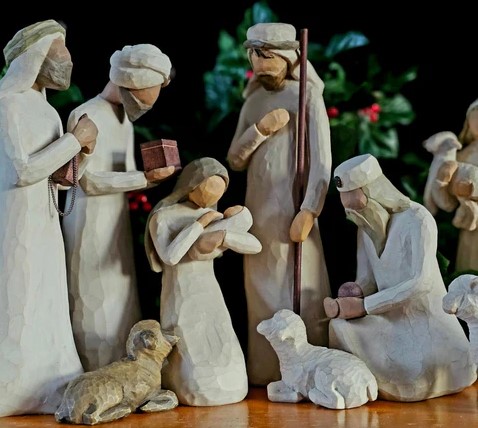
We should ponder this for a moment. Prior to salvation, we were under the banner of Satan himself and vehemently fought against our Creator just as the enemy continues to do. Think back on your life prior to then and I challenge you to prove you were “good.” Each of us were rebels against God, enemies as vile as the devil and his minions. In this war, unlike any other war, the victor won not by killing and pillaging, nor by attrition, but by willingly sacrificing Himself for His foe. The great King entered this world covertly in the form of the most vulnerable of all creatures, a human infant. God reduced Himself to a creature that could not even control its bowels, and surrendered Himself into the hands of two young inexperienced Jewish parents. Think about the magnitude of this act! “The Eternal Being, who knows everything and who created the whole universe, became not only a man but (before that) a baby, and before that a fetus inside a Woman’s body. If you want to get the hang of it, think how you would like to become a slug or a crab.” C.S. Lewis, Christmas Reflection on God Descending
Look at what He accomplished through His own obedience and surrender to the Father’s will. It is this Man to whom we must unconditionally surrender our arms. Each of us were His enemy, belligerents who railed against Him, fought Him at every turn, and then ultimately murdered Him.
I think it is very rare, if ever, for one receiving salvation to surrender all. We may think that we have, but then life creeps in and we find that we have only surrendered parts of our lives. We are obedient in those areas surrendered, mostly anyway, but remain defiant in the ones we still cling to. If you think about this what you will discover is that it rings true. What we normally see at the time of salvation is one’s commitment to Christ is heartfelt, and accompanied by deep emotions, regret, and repentance. This is a work of the Holy Spirit and it is a surrender leading to salvation, but it is not a complete surrender. The flesh is still alive and well within. The proof of this statement is found when our salvation experience has “settled,” and we come down from the mountain top experience and enter the valley of the day to day humdrum of life. Temptations begin, and while on the mountain top with Jesus we could easily just shrug them off, but now they become harder to battle. We tell ourselves we want to surrender these things, but yet we revert right back to them when temptation becomes too great. We are weak and fickle creatures who proclaim allegiance to Him, all the while succumbing to the slightest of temptations. Rather than apply the Christian perspective of surrender and obedience, we make an attempt at that lesser, the mere obedience, when we should be letting surrender take the helm. An entire shift of one’s perspective must take place in order to apply the New Testament mindset of surrender and obedience. Our resistance to this application is, if we are being honest, because we don’t want to let go of that particular sin, want, or desire. Thus, outwardly we are obedient, but inwardly we remain defiant. We have become the modern pharisee in our practice of mere obedience, as well as false surrender.
Viewed from this angle it is much like practicing a sort of law, or legalism, and as we previously learned, in mere obedience you can be obedient and yet remain defiant. This paradigm will also have to be surrendered. In this mode, the new believer (and old alike) continues to seek God’s favor, tries to earn his salvation by good works and forsaking specific sins. While neither of these in and of themselves are wrong, the motive is. One cannot curry favor with our Creator or earn salvation. This is the trap that many fall into because they have difficulty in accepting the fact that they cannot earn salvation, nor can they pay God back. This is quite possibly the hardest lesson learned. There is nothing we can do to make God love us more than when He surrendered Himself to the Cross. Nothing. Once we grasp this, then the realization that God no longer remembers our sins, that they are indeed as “far as the east is from the west,” can be visualized and we then begin to see ourselves as His sons and daughters. This is yet another level of surrender.
Many of us did not have loving or nurturing fathers, or mothers for that matter. Those parental relationships tend to shape our view of God to a greater degree than we realize. We always initially see God through the lens of our natural fathers. If our father was not a nurturer, aloof, and unloving, you will view God in the same way. If your father was cruel, you will be much less likely to trust Him as someone else might. If love was dispensed as a reward for good behavior in your home, it will reenforce the belief that even God’s love must be earned. It is getting past these views and changing our perspective of God when we begin to see Him as our real Father. He is the One that truly never will abandon us or forsake us.
Because of the Cross, God looks upon us through a filter of Jesus Christ’s blood. He sees us as pure; we are little christs. If God doesn’t condemn us, then we cannot even condemn ourselves. Once we lay hold of this facet of Christ’s sacrifice, our entire life changes. Keep in mind, God will not settle for a part of us, He wants the whole thing and will accept nothing less. He makes His home within each of us and will not share it with anything that has not been surrendered to Him. He wants to make each of us anew, into something beautiful and radiant. “Therefore, if anyone is in Christ, he is a new creation; old things have passed away; behold, all things have become new.” 2 Corinthians 5:17
As noted, sparingly few (if any) surrender all upon salvation, which means that for most people, surrender is incremental. It is a gradual thing, a slowly giving up of old ways of thinking, habits, and behaviors through one’s obedience. By relinquishing one’s own will in a specific matter, a transformation takes place from obedience to surrender. As we give up more of the self, the more surrendered we become. And the more we are surrendered, the easier it is to be obedient, thus, to further surrender.
The Apostle Paul was a man who personally knew surrender and it was though his surrender that he was enabled to suffer so much for Christ. He was well acquainted with suffering and considered himself fortunate to have done so for Jesus. The portrait of a man’s surrender is captured nowhere more beautifully than in Paul’s describing his own experience in Galatians 2:20,
“I have been crucified with Christ; it is no longer I who live, but Christ lives in me; and the life which I now live in the flesh I live by faith in the Son of God, who loved me and gave Himself for me.”
Surrender is not a new thing. It has been around for a very long time, even before the beginning of Creation when only God and His love was present. Larry Eubanks described it this way, “Surrender is woven into the person of God as a Trinity of Love. True surrender isn’t a response to defeat; it’s a response to love.” It can be difficult to understand surrender, but it is something we must strive to grasp; our very lives depend upon it. I often use the analogy of one kneeling before a king to help explain surrender. I believe it is an accurate depiction of what is taking place in our souls when we surrender to Christ.
You must picture yourself kneeling before your King, not in the typical genuflection, but both knees are planted firmly on the ground, your head is bowed and your neck outstretched. It is a position of submission, as well as one in preparation for execution. All of time hinges upon this moment because your fate rests in the King’s hands. If you have received Him, surrendered to Him, you will live. As you kneel before him, you hear movement, and it is obvious that the King has arisen from His throne, you cringe as footsteps approach you. No king need ever leave his throne and lower himself to a servant, but this is no ordinary King. You have been a rebel your entire life, you have fought against Him every step of the way and refused His command over you. Many have suffered at your truculent hand, and the wake of destruction you have left behind requires a reckoning. The footsteps stop. Your heartbeat quickens as you brace yourself for the final blow of His sword against the nape of your neck. Today, this day, you will face your own death. You squeeze your eyes tightly shut in preparation and begin to wonder if you will feel pain. The seconds seem to stretch on eternally, when suddenly something touches your face! You violently recoil, but quickly begin to calm as you feel a hand sliding under your chin. You are confused, but you sense gentleness in that touch. The hand slowly raises your face as you open your eyes and it is then that you see your King is kneeling right in front of you. Your eyes meet His and what you see in that piercing gaze is not disdain or malevolence, both of which you deserve, but beauty beyond measure; you see a King who possesses a greater weapon than any ever constructed. This King is filled with love. This King is love. As He looks into your eyes, He asks, “Do you love me?” And in that moment, you know that you will die, you will willingly die a death to yourself because you cannot but totally and completely surrender to this King.
Each believer is called by Him to salvation. It is His work alone. He saves us not because we are such wonderful and loving people, but because He is a wonderful and loving God. Once sealed by Him, our great King, our part is to implement the scriptural view of obedience and surrender into our lives and do as Paul instructs each of us, to “…work out your own salvation…” This simply means we are to carry to completion what God has begun in each of us. It is a cooperative effort, though our part is secondary to His; our part is obedience and surrender. What you will find is that the more obedient you become, the more you surrender to Him. As you surrender that old selfish, bitter, angry, hedonistic human side of you, that old you begins to die off. The old you is being crucified a piece at a time.
All of us will one day leave this world as the myriads of others that have gone before us. Upon arriving at that final destination, we will encounter the living Christ. Scripture records that we will hear one of two responses when we meet Him, one bringing unimaginable joy, the other, anguish and untold horror. I want each of us to experience looking into our great King’s eyes and hearing, “Well done, good and faithful servant,” and I cringe at the thought of those other words, “Depart from me, I never knew you.” We will each hear one or the other. It is of paramount importance to be obedient and to surrender all to Him. Whatever pleasures this life holds for us are ephemeral and pale in comparison to the unimaginable rewards set before us. I challenge you to lay hold of surrender and obedience and never let them go, own them, and let them become a part of you.
“The world has yet to see what God can do with and for and through and in a man who is fully and wholly consecrated to Him.” D. L. Moody
“The greatness of a man’s power is the measure of his surrender.” William Booth
C. Klingle





 Curtis Klingle
Leave a comment